Rebuilding a Brand From the Inside Out: How Tech and Team Engagement Drive a New Strategy
BY Carrie Snider
|
March 02, 2026

As a 116-year-old company, ABM Industries looks very different today than it did in over a century ago. Recently, the company set out to redefine itself—but how it approached that reinvention was critical.
Founded in 1909 as a window-washing business, ABM Industries has grown far beyond commercial cleaning into integrated facilities management, serving airports, universities, and complex infrastructures across 14,000 client sites with 100,000 frontline employees.
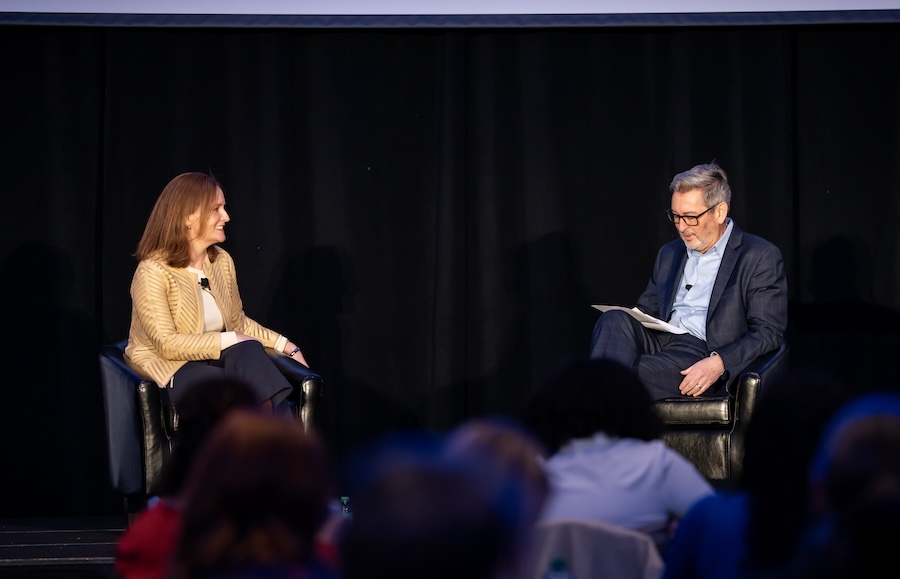
Three years ago, leadership realized the company’s story hadn’t kept pace with its transformation. Cary Bainbridge, chief marketing officer at ABM Industries, spoke during a fireside chat at From Day One’s Atlanta marketing event about how technology and internal alignment drove ABM’s brand evolution.
“When you think about our evolution, and what I’ve been fortunate to be part of over the last 20 years, it’s continuing to see that evolution and tell a new story,” Bainbridge told session moderator Stephen Koepp, From Day One’s editor in chief and co-founder.
In recent years, ABM has expanded its capabilities, integrating soft and hard services under single contracts and modernizing its operating model. The shift wasn’t cosmetic. It was strategic, says Bainbridge.
The company invested heavily in upskilling its workforce and embedding technology into daily operations. Today, frontline employees use mobile devices that direct workflows in real time, while managers and clients gain visibility into building operations through centralized digital platforms.
Reflecting the Inside Change
The brand refresh, anchored in the theme “Driving Possibility, Together,” needed to reflect those internal changes.
“It all started with alignment to our business strategy,” Bainbridge said. “We were going through a system transformation internally. The brand needed to match who we’ve become.” That transformation included modernizing enterprise systems and introducing new tools across the workforce. Leadership was intentional about pacing the change.
“How much change can our teams consume at any given time?” Bainbridge recalled asking. “We wanted people to feel the change and see that it was happening—so when we empowered them with a new story, it was something they could believe in.”
Rather than leading with marketing, ABM focused first on operational credibility. Employees needed to see proof before they could authentically champion the new brand.
The transformation began internally. ABM pressure-tested messaging with employees, launched the brand inside the organization first, and positioned team members as its primary storytellers before rolling out targeted external campaigns. “We knew we had to start on the inside,” Bainbridge said.
Smart Growth, Not Just More Growth
As ABM expanded into electrical infrastructure, microgrids, and mission-critical environments like data centers, its ambitions began to outpace public perception.
“We had an alignment problem,” Bainbridge said. “Customers would say, ‘I didn’t know you did that.’ And internally, our team members would say, ‘I don’t know all that we do.’”
Closing that gap required discipline. Rather than chasing volume, ABM intentionally targeted higher-value integrated solutions in sectors such as airports, higher education, semiconductors, and data centers.
To support that strategy, the marketing team deployed AI-powered lead scoring and machine learning tools to prioritize quality over quantity—resulting in a 4% improvement in lead conversion rates in the first year.
AI also expanded access to performance insights. By layering generative AI into marketing dashboards, ABM enabled more employees to query data directly, freeing analysts to focus on advanced modeling and strategic insights.
Bainbridge emphasized that marketing’s credibility depends on measurable contribution to growth. At ABM, sales and marketing operate under shared leadership, with aligned KPIs tied directly to revenue in priority segments. “When I stand in front of our leadership team or our board, it’s about our contribution to new sales growth,” she said.
Brand as a Cultural Strategy
For Bainbridge, the evolution of the CMO role requires both culture and ROI. ABM’s CEO is invested in internal culture, reinforcing the idea that the brand begins with employees.
Employees represent the company to customers, recruits, and their communities. Internal alignment, therefore, becomes a business driver—not just a communications effort. By modernizing systems, upskilling employees, aligning leadership, and embedding technology into operations, ABM ensured its brand transformation reflected real change.
Marketing’s role, Bainbridge said, is to connect those dots—so growth strategy, culture, and customer experience move in the same direction.
Carrie Snider is a Phoenix-based journalist and marketing copywriter.
(Photos by Josh Larson for From Day One)


