The Invisalign Story: A Case Study in Marketing a Revolutionary Product
BY Jessica Swenson
|
May 11, 2026

While Invisalign is known for changing lives through innovative digital orthodontics, the company has had to think creatively to actually earn that relevance among its customers and partners.
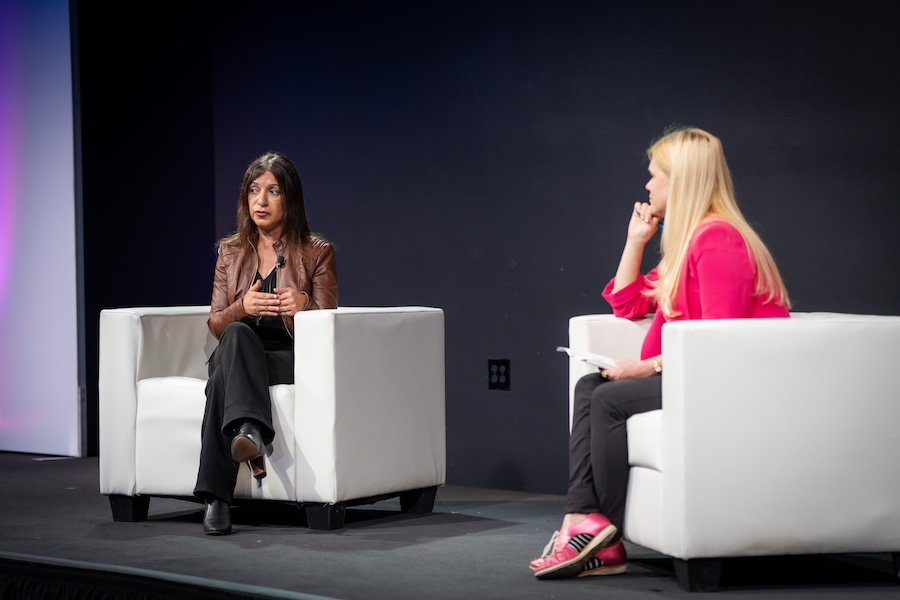
The evolution and strategy behind its marketing approach was discussed by Kamal Bhandal, SVP of the global Invisalign brand for Align Technology, during a fireside chat at From Day One’s Silicon Valley marketing conference. The session was moderated by independent video host, journalist, and producer Claire Reilly.
“Really identify the stakeholders in your customer journey, so that you know that you’re attacking points of failures or points of delight,” said Bhandal. Invisalign started by identifying the service providers who would comprise its delivery network, and invited them to help test and refine its products, she says.
To maintain the partnership and trust of their clinical partners, the company makes continuous efforts to understand and meet their needs. “We’re looking to understand their business needs, their clinical needs, and the clinical outcomes that they’re looking for, and then designing products that meet those clinical needs,” she said.
Invisalign also engages in peer-to-peer training, education, and certification programs to prepare clinicians to use its products, as well as conferences and specialized sessions with deep dives into treatment techniques.
Other key stakeholders in the Invisalign customer journey include end users, decision-makers or influencers, and frontline staff. Understanding each of these stakeholders is important, she says, as each can impact those points of failure or delight. The company spent its early days proving that the product worked, before shifting to a lifestyle marketing approach that highlighted how Invisalign could seamlessly fit into consumers’ lives.
Continuous innovation prepared the company to manage increasingly complex cases, which broadened its scope. “We always first start with understanding the consumer, understanding the person, and what their lives are like,” said Bhandal. This helps the brand focus its marketing less on product features and specs and more on solving key pain points that matter to the customer.
By studying the real lives of teens and parents, from social pressures and confidence issues to practical constraints like family schedules and multiple responsibilities, Invisalign can position itself as a product that reduces friction by fitting into the user’s life rather than disrupting it.
She cited two examples that appeal to decision influencers (parents): damage to traditional braces during sporting events can cause emergency orthodontist visits—with Invisalign, these visits are greatly reduced. Additionally, the simplicity of hygiene as compared to traditional braces makes it easier for teens to maintain. For the teens themselves, the draw becomes straighter teeth and increased confidence without the stigma of traditional braces.
Solving these problems for families also earns Invisalign its relevance in current culture. “We think about not talking at people, but really creating a conversation and being a part of culture,” says Bhandal. “Brands who integrate into culture, who move at the speed of culture, are brands who win.”
Invisalign shifted its branding from a top-down to a community-driven approach, using real stories from patients and doctors to shape the brand. Cultural participation and user-generated content are key.
As a healthcare-focused company backed by science and technology, however, it doesn’t tie itself to any one category of social influencers. It partners with lifestyle, fitness, beauty, and health influencers who represent the brand’s typical customers and showcase Invisalign as one part of their well-being process.
A core takeaway from Invisalign’s brand evolution is to become obsessed with understanding your customer and what their life is like. “Not through just quantitative data and quantitative data analysis,” said Bhandal, but really dig into who your consumer is, who is influencing the decisions along the way, and what they are thinking about. “Become super obsessed with understanding human behavior of those that are involved in your buying journey.”
Jessica Swenson is a freelance writer and proofreader based in the Midwest. Learn more about her at jmswensonllc.com.
(Photos by Josh Larson for From Day One)