Tech That Connects: Using Tools to Support Frontline Workers
BY Emily McCrary-Ruiz-Esparza
|
May 28, 2026

“In most workplaces, tech fails on the front line, not necessarily because the interface is wrong, but because nobody really engaged with the frontline workers about the problems they’re actually struggling with,” said Anita Jivani, global head of innovation at digital and cloud services firm Avanade. “It’s a design-thinking failure, not necessarily a budget failure.”
In fact, small budgets can be “clarifying,” she said during a panel discussion at From Day One’s May virtual conference on frontline workers. Constraints steer the focus toward problems that need solving. “Picking one workflow or one friction point, and then co-designing it with [frontline workers] produces both adoption and relevance.”
Jordan Lewis, the senior director of product at workforce management software Deputy, has recently watched companies move away from “top-down implementations where the senior leadership decides on the tool and then rolls it out, and employees have to work with the tools they’re given,” he said.
Instead, he pointed out, companies are choosing a consultative approach “where the employees and those frontline workers are actually part of the evaluation process.” Businesses are recognizing collaborating on tools can reinforce engagement and retention—and that’s what they want, especially right now.
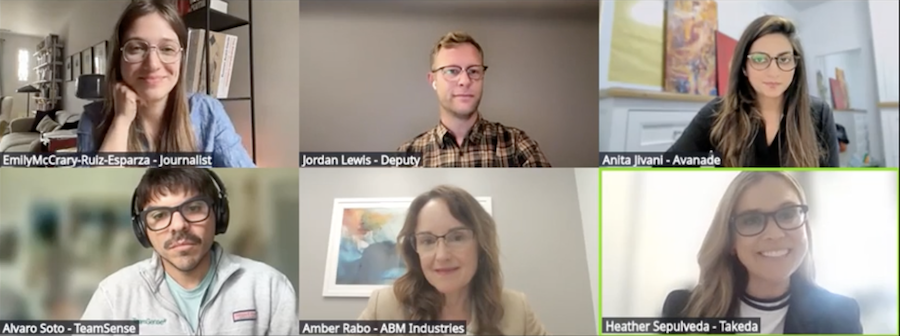
Good tech also requires good access points. Facilities management provider ABM has a frontline workforce distributed across stadiums, airports, geographies, and buildings, “and oftentimes they don’t have access to meeting rooms or technology or desktops,” said Amber Rabo, the company’s VP of learning and development.
In fact, many frontline workers don’t have access to devices of their own, or they may be first-time tech users, and some may be working in multilingual workplaces, so the company came up with its own easy-to-use in-house platform, called ABM Connect, which links frontline workers with operational and enterprise leaders for two-way communication, offers short training sessions, and simplifies log-in with facial recognition.
Companies are building better tech for the frontline workforce by listening carefully. In June 2026, pharmaceutical firm Takeda will inaugurate a new CEO, and head of talent intelligence Heather Sepulveda has been taking part in listening tours with the new leader to “understand and hear things firsthand, instead of them funneling up through a game of telephone.”
First, everything has to be mobile-friendly, said Sepulveda. She heard “loud and clear” from employees that they were missing out on company-wide announcements and job opportunities due to ineffective tech that wasn’t designed for frontline workers’ needs, working styles, and schedules. “Whatever it will take,” she said, “we have to make it easier for them.”
At TeamSense, which uses text messaging to facilitate communication with the front line, VP of product, Alvaro Soto pointed out that “we didn’t choose SMS because it’s clever, we chose it because it works. “Someone on a 5 a.m. shift at a meat packing plant or a manufacturing floor may not have a company email,” said Soto, so TeamSense requires neither app nor log-in credentials, just the ability to text message, and it can currently support more than 30 languages.
“We see the adoption of TeamSense become so fast and so powerful because we’re removing all that friction.” Why? Because it’s a tool built specifically for the frontline workforce, first.
Emily McCrary-Ruiz-Esparza is an independent journalist and From Day One contributing editor who writes about business and the world of work. Her work has appeared in the Economist, the BBC, The Washington Post, Inc., and Business Insider, among others. She is the recipient of a Virginia Press Association award for business and financial journalism. She is the host of How to Be Anything, the podcast about people with unusual jobs.
(Photo by Patamaporn Umnahanant/iStock)