Matching Employee Expectations to Economic Realities: Where Leaders Should Focus
BY Kristen Kwiatkowski
|
January 07, 2026

From expanded mental health support to virtual healthcare access, employers have adapted to employees’ evolving needs since Covid. But those offerings are only part of the picture. Many workers are also asking for more affordable healthcare benefits. How can employers respond to these requests, and what other forms of economic support do employees expect from company leaders?
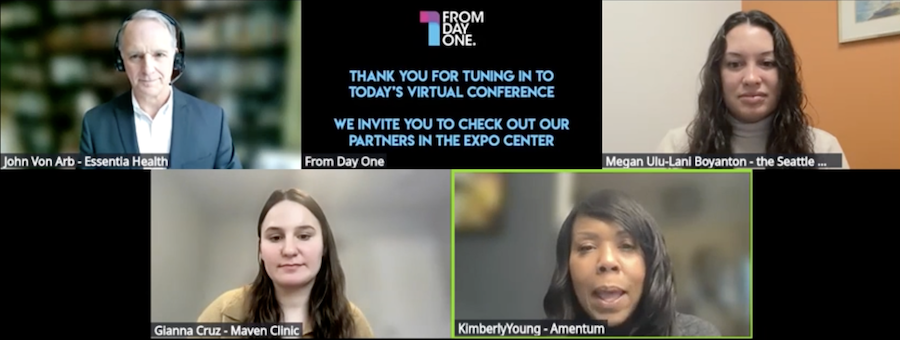
These concerns were addressed during an executive panel discussion moderated by Megan Ulu-Lani Boyanton, business reporter with The Seattle Times, at From Day One’s December virtual conference.
Ulu-Lani Boyanton started off the session by asking what the panel guests often hear from their employees regarding healthcare wants and needs.
“Employees want comprehensive benefits that make showing up to work easier as they grow and raise their families and care for their personal health,” said Gianna Cruz, director of client success at Maven Clinic.
“In our latest State of Women’s and Family Health Report, 69% of those who were surveyed said that they would take or have considered taking a new role or a new job because it offers better reproductive and family benefits to them and their families,” said Cruz.
“I think what we’re really seeing now is a push to personalization,” said John Von Arb, VP of total rewards for Essentia Health. Expanding voluntary benefit strategies in addition to the core benefits offered is what people are now looking for, he says.
“Generational differences within the workforce today do drive a lot of the conversation around what the needs are because one size does not fit all anymore,” he said.
Kimberly Young, SVP of total rewards at Amentum, a global leader in innovative technology solutions and advanced engineering, highlighted the importance of affordability and a work-life balance as benefits sought after by employees.
“Obviously affordability is the number one priority, so a lot of the feedback is targeted towards the escalating costs,” said Young. “From a premium perspective they want turnkey care for a much lower cost.”
“And they want something that covers a work-life balance,” added Young. “We find ourselves today trying to balance all of that.”
How Employee Needs Changed Post-Covid
The needs of employees and their economic concerns have also changed since Covid.
For healthcare industry professional Von Arb, it’s undeniable that Covid played a big part in changes within his organization. It was a “game-changer” for the industry, he said. Mental health support became a focal point, with about 150 employees trained in peer-to-peer support, he said.
Since Covid, clients now view Maven’s benefits as a core part of a strong, effective benefits package rather than a nice-to-have, says Cruz. There’s also more of a focus on overall access to care, and specifically access that might have been limited during Covid. In general, there’s a push for equitable access in a virtual setting at a global scale.
Post-Covid, there’s been a greater emphasis on mental health and wellness, Young says, along with increased focus on activity and flexibility as many employees continue transitioning back to work.
Meeting Employee Expectations Regarding Benefits
The panelists shared a range of approaches to meeting employee expectations, from offering greater choice and flexibility in plans to providing holistic support, chronic disease management, and tools that support lifestyle changes.
Essentia Health strives to handle much of its benefits in house from the health plan perspective, Von Arb says, while identifying gaps where additional support is needed. The organization continues to focus on chronic disease management, covering weight loss medications such as GLP-1s, and exploring options that support lifestyle and life management changes.
The organization also “built out a more robust value-based design strategy,” he said. This is done by getting groups of leaders together from the various departments. Doing so helps to answer the question, “How do we get members to engage with their own health journey?”
Young stated that choice and flexibility based on different plan designs along with a robust mental health program were some solutions her company has offered to employees. “We’ve tried to introduce a variety of benefits that touch all aspects of the employee experience,” said Young.
Cruz added that employers are expanding women’s and family health benefits and that employees increasingly expect more holistic support. She is especially enthusiastic about Maven’s maternity program, which helps employees in rural or underserved areas access care and supports them throughout pregnancy and the post-pregnancy period.
How Technology Plays a Role
Technology is also changing workers’ support in a major way. “Technology extends the ability for individuals to access, not just care, but high quality care if they live in an area where access is limited for whatever reason,” said Cruz. “Clients really utilize Maven’s round-the-clock virtual support.”
“We’re focused on data-driven personalized coordinated care and helping employers deliver that to their employees and we’re also really focused on offering a seamless patient experience,” said Cruz. Technology and AI can really help members with their journey.
When AI is used, it can help employees navigate all the options from a healthcare perspective, says Young. Personalization is vital because everyone’s journey is different.
But to be effective, it has to be employee friendly, Von Arb said. From an HR perspective, many AI tools have made progress in this area, though some payroll, benefits, and HR systems still lag in using AI to support the employee experience.
Ultimately, the discussion underscored that effective benefits strategies are no longer about adding more offerings, but about designing systems that are accessible, affordable, and responsive to employees’ real lives. As expectations continue to evolve post-Covid, employers face growing pressure to listen closely, personalize thoughtfully, and leverage technology in ways that genuinely support health, well-being, and long-term economic security.
Kristen Kwiatkowski is a professional freelance writer covering a wide array of industries, with a focus on food and beverage and business. Her work has been featured in Eater Philly, Edible Lehigh Valley, Cider Culture, and The Town Dish.
(Photo by Benjamas Deekam/iStock)


