How Does Your Brand Show Up in the New Era of GEO?
BY Ade Akin
|
February 04, 2026

Damien Slattery couldn’t help but notice how fast culture around him had changed during a recent commute on the F train in Brooklyn. The subway car he rode in would have been filled with people reading newspapers or magazines decades ago, but everyone now stared at electronic screens.
For Slattery, the SVP of strategic growth and partnerships at Inc. and Fast Company, this observation highlighted the tremendous shift facing marketers today. The blueprint has been completely rewired, and AI is now directing its future.
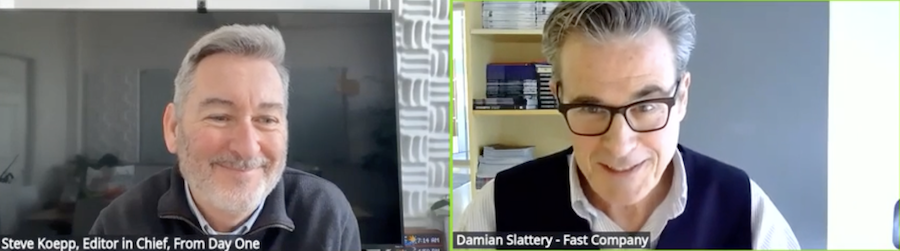
Slattery, a media veteran who has led marketing campaigns for major brands like Time and Sports Illustrated, discussed this technological shift and more during a thought leadership spotlight at From Day One’s January virtual conference. We’ve now moved past the era of search engine optimization (SEO) into a new chapter that’s defined by answer engine optimization (AEO) and generative engine optimization (GEO), he says.
“The AI universe has just re-engineered and reimagined what search prioritizes,” Slattery told session moderator, Steve Koepp, From Day One’s editor in chief and co-founder. “Brand leaders today have to be thinking about these AI models working behind the scenes to cite, summarize, and trust your narrative, your product, your service.”
The Rise of the Answer Engine
The transition from keyword-focused SEO to AI-prioritized AEO represents a fundamental change in how brands must approach content. Slattery recalls the early days of digital search, where the marketing goal was to rank high for specific search queries. Today, AI-powered search engines prioritize providing the best, most concise answer rather than simply listing links to potential answers.
“I had CNBC on early this morning, and they had the OpenAI CFO on from Davos, and she said something that really kind of crystallized our conversations today,” Slattery said. “The best answer is no longer or not necessarily the paid answer, right? The best answer is going to be served.”
Today’s marketing teams should aim to be selected as an authoritative source by AI. “It’s a new muscle we all have to build,” he said. “And it’s going to make us better marketers, better storytellers, and [help] leverage the power and might of AI more strategically.”
Koepp noted this new landscape is fragmented among several competing AI platforms, unlike the Google-dominated era of SEO, where marketers mostly focused on learning the rules to rank high on Google’s search engine. Slaterry says brands must now ensure that their core narratives and data are trustworthy enough to be recognized as the best source of information across multiple “answer engines.”
Building Trust in an AI-Driven World
The age-old concept of trust remains vital as AI transforms the marketing landscape. Slattery points to the Edelman Trust Barometer, which found in 2023 that businesses are more trusted than governments and institutions. That trust has gone local.
“We have to be super rigorous,” Slattery said regarding building trust with targeted audiences. He emphasizes what he calls “trust signals,” which include verifiable reviews, professional credentials, detailed FAQs, and accurate product descriptions.
In keeping and building trust, Slattery warns against losing the human element that makes up the core of branding as organizations rush to adopt AI. He referenced a new campaign from Equinox titled “Question Everything But Yourself,” which uses absurd, AI-generated imagery, like a woman biting a dog that’s really a cake to deliver its messaging. For him, it’s an example of how an organization can brilliantly leverage AI’s capabilities to deliver a profoundly human message.
“Brands need to keep it real,” Slattery said. “That can become the thing that makes AI surmountable for those who feel like, where do I start? You start by keeping your brand human and then chipping away at these things that will make your brand discoverable and trusted.”
This human focus connects directly to its customers, the ultimate targets of a company’s branding. “It’s customers who infuse the meaning into the brand,” Slattery said, recalling a colleague who was turned off by a poorly personalized message on her Starbucks cup. Every touchpoint, from social media to customer service, shapes that personal relationship, and a single misstep can alter perception.
The Impatient, Agentic Future
Slattery also explored the near-future implications of AI and marketing, describing an “impatience economy,” where AI shortens the consumer journey from consideration to purchase into mere seconds. This raises a potentially disintermediating puzzle.
“Once an agent knows the consumer well, the trust follows in the agent, not the brand,” Slattery said. “The agent is winning the relationship and the trust, as this intermediary with the brand.” The risk is that customer loyalty shifts to the AI assistant that knows their preferences, rather than the brand itself.
For chief marketing officers, the mandate is clear. Brands must lean into the new reality of generative engine optimization by ensuring their content is structured for AI discovery, their data is impeccable, and their narrative is both grand and granular.
The journey from the folded newspapers on the F train to the glowing screens of today took a few decades. The next leap will be into a world where AI agents do our searching and synthesize our choices at the speed of light, and that’s coming in the next several years.
“What got you here won’t get you there,” Slattery concluded, echoing management guru Marshall Goldsmith. The work of adapting to the answer engine economy starts now for brands that wish to matter in the future.
Ade Akin covers artificial intelligence, workplace wellness, HR trends, and digital health solutions.
(Photo by Sandwish/iStock)


