Designing an Employee Experience That Engages, Recognizes, and Supports
BY Katie Chambers
|
May 20, 2026

How do you build a culture of care at a construction site? It’s all about perspective. “We’re one of the most inclusive industries in the world because it takes 300 skill sets to put together a project any day of the week,” said Kabri Lehrman-Schmid, project superintendent, SeaTac construction leader, at Hensel Phelps. Taking care of a crew’s needs can mean anything from setting up a coffee station to applying for parking permits for them with the city. It’s all about paying attention to employees’ unique needs, and responding accordingly.
A great employee experience considers all facets of a worker, from well-being and compensation to recognition and growth. Creating an environment where employees feel genuinely engaged and supported throughout their development was the focus of a panel discussion among leaders including Lehrman-Schmid at From Day One’s Seattle conference.
Today’s Workplace Trends
Post-pandemic, many organizations are leaning into what Maris Krieger, senior director, talent, learning and development, at Hearst Corporation, calls a “culture of care,” It’s all about doubling down on providing additional healthcare and childcare benefits as well as learning opportunities. “We are a global company, a very diverse portfolio company, so we are continuously working to make this experience that we have feel connected and shared across the globe,” she said.
As many workers return to the office, they are again spending “10 to 15% of employee time commuting,” said Chinmay Malaviya, co-founder and CEO of Ridepanda. “Post-pandemic, more people now acknowledge and recognize this as a painful, stressful, anxiety-inducing time. Employees are expecting different things,” he said. Malaviya identifies this as an opportunity to provide solutions that ease the strain and help employees make the most of their time, such as in-office wellness activities to preserve their free time or carpool options to improve affordability.
Ridepanda works with employers to rethink commuting as part of the overall employee experience rather than just a logistical necessity, says Malaviya. By working to address the daily frustrations tied to commuting, it aims to support employee well-being while also helping companies strengthen workplace satisfaction.
Due to remote work options, many large corporations are now finding their employees scattered across different locations. At Hensel Phelps, says Lehrman-Schmid, employees already felt this way, given the nature of the company’s work spread across many individual job sites. It’s HR’s role to bring everyone together, despite the physical distance. “I’m in that position as a job site leader, to be able to take the great initiatives we’re doing at a corporate level and actually make it applicable to the production-oriented systems that we have in very dynamic projects that could be high rises, that could be tunnels, and make it applicable to our people in the work that they do daily.”
Where Culture and Benefits Intersect
Katie Bunker, VP, HR, North America at Cotiviti, said leaders should be “very deliberate about the employee experience. It’s like culture. If you don’t look after it, it just happens.” This means understanding the experience of stakeholders at the organizational, managerial, and individual levels. “We set out to define what we wanted the employee experience to be like. What does it mean to work here, and what does it mean to experience it? What’s our mission?” Bunker said. These should guide every touchpoint, from first applying for a job through retirement. Her team relies on employee engagement surveys to gauge whether their strategies are working, and they just closed one with a 91% response rate. “That’s because you created a culture where they feel like their opinion matters,” said moderator Diana Opong, independent reporter and host.
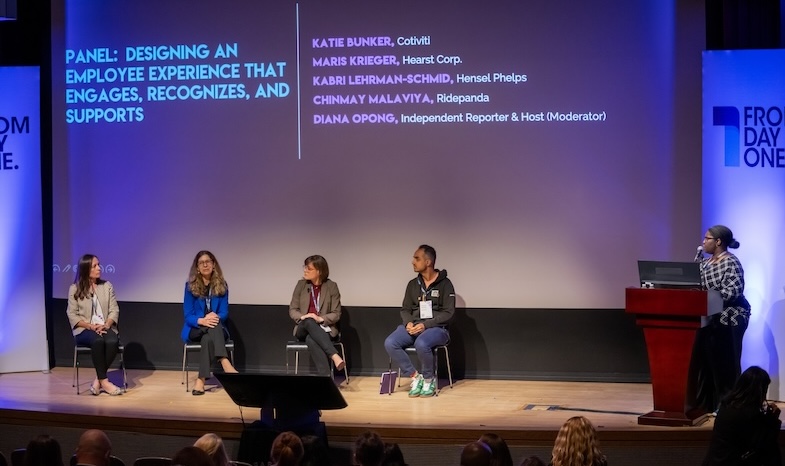
At Hearst, Krieger said, “We have shared culture, we have shared principles, but we still need to give flexibility to different organizations.” For example, their New York office is now mostly in-person with some hybrid options, while the Seattle office skews more remote, especially for tech workers who were initially hired to work exclusively remotely during the pandemic. To keep those folks engaged, the company has one week per month with in-person collaboration events.
When it comes to AI, organizations should focus on educating employees while also allaying their fears. Krieger’s company asked staff “AI champions” to opt in and help educate their peers while emphasizing the human element of using the technology, “the critical thinking, the judgment, even delegation. We are really trying to make it non-threatening,” she said.
Hensel Phelps is using AI to augment and improve existing processes, such as using an app called “Smart Tag It” to identify hazards associated with each day’s tasks. “This is a process that has existed forever, but in taking AI to it, not only are we providing education to teams [and] to leaders that traditionally have not received education in technology, but we are also providing feedback on, ‘Was that an interactive session? What questions can you ask your crew to make sure that they better understand this situation?’ It’s building these collaborative skillsets in positions that have not traditionally had that opportunity,” Lehrman-Schmid said.
While Krieger has seen how AI has put some areas of her organization’s business, including social media, “under attack,” it’s also provided more human opportunities as employees continue to upskill in new technologies. “We have been doing more things in collaboration across the organization, I feel that it has even strengthened human collaboration. We haven’t switched to tools and machines and robots and AI, but human collaboration comes very naturally [in] that different functions and teams are coming together and trying to solve a problem.”
As HR teams look to amp up the employee experience, Bunker encourages them to approach it from a business perspective rather than an HR one, especially when seeking buy-in from leadership. “So, it’s not a ‘me versus you,’ [instead] it’s a data set.” Be prepared to share the hard numbers demonstrating the financial and business benefits of investing in employees’ well-being.
The people should always be the priority. “My grandmother used to say, ‘You spend five days out of every seven at work, so you better like what you’re doing and you better like who you’re doing it with,” Bunker said. “And I think in the roles that we have, we’re stewards of that, and we can really influence that. So, we try to be very intentional about that.”
Katie Chambers is a freelance writer and award-winning communications executive with a lifelong commitment to supporting artists and advocating for inclusion. Her work has been seen in HuffPost, Top Think, and several printed essay collections, and she has appeared on Cheddar News, iWomanTV, On New Jersey, and CBS New York.
(Photos by Josh Larson for From Day One)