How Patagonia Became a Global Leader in Doing Well by Doing Good
BY Katie Chambers
|
December 01, 2025

Despite his great corporate success, Patagonia founder Yvon Chouinard doesn’t have a computer, cell phone, or email address. “[He] is a self-proclaimed dirt bag. He’s a mountaineer. He is most comfortable roaming in the wilds of Patagonia. He does not like to be governed,” said moderator Emma Goldberg, reporter at the New York Times.
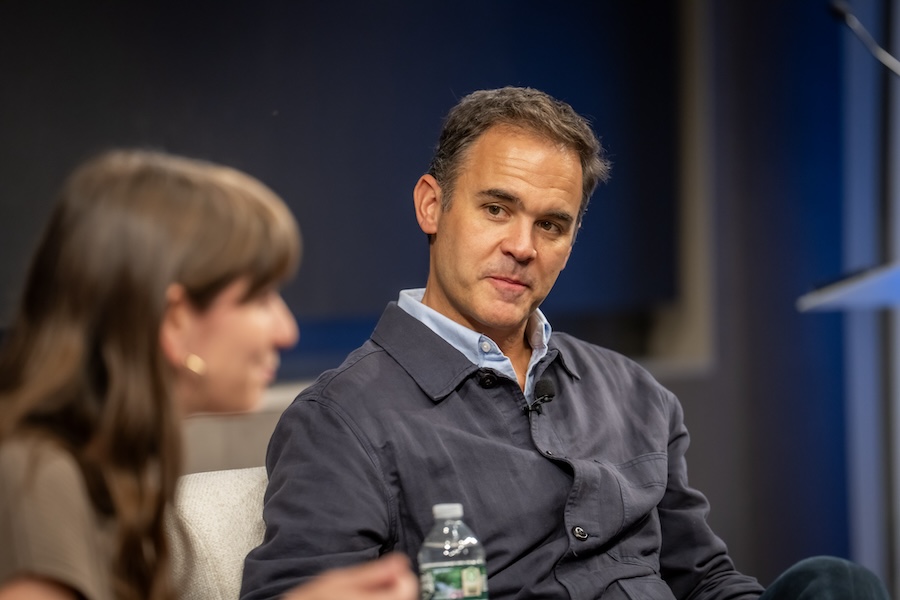
“So where did his ambition come from?” Goldberg asked David Gelles, reporter at the New York Times, and author of Dirtbag Billionaire: How Yvon Chouinard Built Patagonia, Made a Fortune, and Gave It All Away. Gelles and Goldberg spoke during a fireside chat at From Day One’s Midtown Manhattan conference.
Turning Rock Climbing into Business
Don’t let the title of the book fool you: “In the rock-climbing community from which he came, ‘dirtbag’ is actually the highest compliment. It refers to someone who’s so un-enamored with materialism that he’s literally content to sleep in the dirt if it means he’s that much closer to his next adventure, to his next climb,” Gelles said. What offends Chouinard is the other half of the book’s title: billionaire.
“Ambition is a word that I think he has a very fraught relationship with. It’s important to know that he never set out to build a big company. It sort of happened by accident, and he had to make peace with it along the way,” Gelles said. His ambitions were to be away from people. “He did everything in his power to be in nature, to be rock climbing and fishing, and those are the places where he drew his product inspiration.”
Gelles notes that Chouinard’s business is built upon paradoxes: a desire to protect the planet while leaving a significant carbon footprint due to the production of its products; an instinct to protect employees while never letting them hold equity; a hope to reduce mindless consumption while becoming a brilliant force for viral marketing.
As his company grew into a multi 100-million-dollar business, Chouinard felt a responsibility to take care of his thousands of employees, says Gelles. “Patagonia only had one round of real mass layoffs in its career, and it was such a traumatizing experience to Chouinard and his family that they never wanted it to ever happen again” he said. “As a result, the company kept getting bigger by virtue of just the momentum.”
Patagonia’s Corporate Values
One of Patagonia’s keys to success is in its corporate values, which came naturally to Chouinard. “From a very early moment in his life and business career, Chouinard and his team understood what they cared about, and those things were very simple,” Gelles said. “They wanted to run a responsible business. They wanted to use their profits to preserve the natural environment, and that meant large-scale land conservation. They wanted to fund grassroots environmental activists. And they wanted to run a sort of company that they would want to work at.”
This consistency is what helped instill Patagonia at top-of-mind among its competitors. “The reason Patagonia, although it’s a relatively small company, has such an outsized brand impact, such a big place in our collective imaginations, is because they kept doing the work. They kept coming back to those same values, and the values never changed.”
Even in times of political strife, Patagonia doubles down. “In 2017, Patagonia led a lawsuit against the Trump administration over its efforts to reduce the size of national monuments. At that moment, it went black on all its websites and put up a new image that said, ‘the President stole your land.’”
Chouinard even appeared on CNN to decry the administration. Its resistance continues to this day, as current CEO Ryan Gellert calls out other corporations for bending the knee. “Patagonia has never been afraid to be political, and at this moment, continues to speak out when almost every other brand has gone silent,” Gelles said. They have the power to do this because the company is privately held and insulated from the pressure of a board of public shareholders.
Of course, nothing is perfect. “The company scaled, and they toggled back and forth between the success of the business, the desire for quality products, and the desire to manage the growth. [There] were the moments where that balance went astray,” Goldberg said. Gelles says that while the title of Chouinard’s own book is “Let My People Go Surfing,” and the Ventura campus has showers and flexible hours for that very purpose, “Patagonia employees work really, really hard, and it is at times a very demanding and cutthroat place to work.”
Chouinard experienced a crisis of conscience after being named to the Forbes list in 2017, and renounced his ownership of the company in 2022. “But in doing so, he made a very deliberate choice not to share the wealth with his employees. These are some people who had worked there for 50 years at that point. And when you think about his priorities, I would argue that the well-being of his employees is a part of a matrix, but it is not the primary goal for that company or this manager.”
The Future of Patagonia
Goldberg posits whether the recent election of incumbent NYC Mayor Zohran Mamdani, a Democratic Socialist, can be seen as commentary on the next generation’s distrust of big business. “No,” Gelles said. “I know plenty of old people who are still optimistic and are still working hard to figure out how business can be a force for good. I also know tons of young amoral finance bros. So, no, I don’t think there's a generational divide. I think there’s a spiritual divide.” He notes that in an interview with the Financial Times, Mamdani counted Chouinard among the top of the list of business leaders who had earned his respect.
Gelles hesitates to name which executives might become the next Yvon Chouinard. “Chouinard lived a singular life, and Patagonia is a singular company,” he said. “What I can say is that I see a lot of people wanting to be like Yvon Chouinard and Patagonia and realizing how hard it is. What Chouinard told me over and over again is that the moment you have external shareholders, the moment you take VC money or private equity money, or you go public, you are going to have a really hard time making good on your values, which is why, despite having the opportunity over and over and over to take outside capital, he always resisted it.”
Now Chouinard, aged 87, is looking to the future. “He understands that Patagonia has served as a symbol for what the business community can do, and the potential that I think is inherent in capitalism as being a possible force for good. And at the end of the day, because he had such high standards, he is also at a very deep level dissatisfied, which is why he’s still pushing Patagonia to do the work.”
He made waves when he announced his succession plan in 2022: the organization will remain for-profit, but its dividends will be donated to protect the planet. Per the company’s website: “Earth is now our only shareholder.” Gelles hopes other business owners will take note of Chouinard’s selflessness. “There are plenty of other philanthropic business leaders, and I think we’ll see more of them in the years ahead.”
Katie Chambers is a freelance writer and award-winning communications executive with a lifelong commitment to supporting artists and advocating for inclusion. Her work has been seen in HuffPost, Top Think, and several printed essay collections, and she has appeared on Cheddar News, iWomanTV, On New Jersey, and CBS New York.
(Photos by Josh Larson for From Day One)


