Employer Listening With Intent: From Feedback to Follow Through
BY Grace Turney
|
February 25, 2026

Around 2009, a few years into his career at CarMax, Craig Cronheim had a habit he now describes with a mix of nostalgia and self-awareness. After visiting a store, he’d board a plane home to Richmond with a mental list of every question and suggestion he’d heard from associates that day, and he’d stay up working to resolve each one. “I thought I was the feedback loop,” he said.
It worked, for a while. But as his responsibilities grew, Cronheim learned something that has shaped CarMax’s entire approach to employee listening: personal accountability can only scale so far. The infrastructure has to carry the weight.
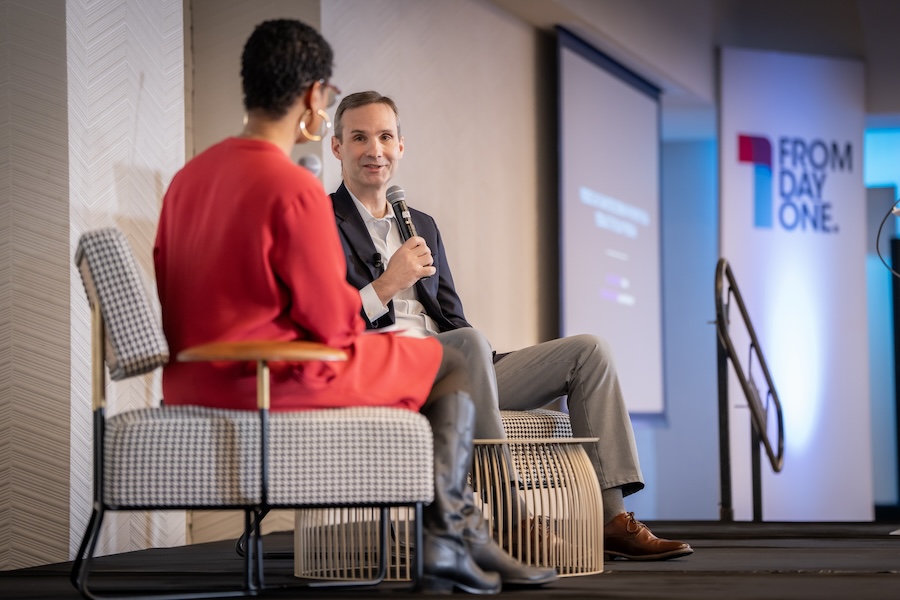
Cronheim, SVP and chief HR officer at CarMax, shared that progression during a fireside chat during From Day One’s Washington, D.C. conference. Moderated by journalist Krissah Thompson, the conversation explored how CarMax has built a disciplined, trust-generating feedback system across a workforce of more than 28,000 associates.
Cronheim was careful to make an important distinction: “Listening is the beginning, but not the end,” he said. At CarMax, the process follows three steps: understand, act, and close the loop. Each stage matters, but the third is where trust is either built or broken.
“You can collect the feedback. You can actually do something with it. But if your teams don’t know what you’re doing with it, and they don’t know why, you’re really missing out,” Cronheim said. “They’re not going to trust you, because they’re going to see some action, but they’re not going to be able to connect the dots.”
A Well-Oiled Feedback Machine
Twice a year, CarMax surveys every associate, says Cronheim. The response rate hovers around 90% – a figure Thompson found remarkable for an organization its size. Cronheim credits the consistency of follow-through, rather than traditional incentives. “What we incentivize with is taking action on the feedback,” he said.
After each survey cycle, two tracks run in parallel. Managers at all CarMax locations receive their team’s results and are required to submit an action plan. An astounding 87% did so in the most recent cycle, he says. Meanwhile, centralized HR home office teams receive aggregated feedback sorted by topic and develop their enterprise-wide action plan. The whole picture is then packaged into an all-associate communication CarMax calls “Your Feedback in Action,” which outlines major themes of associate feedback, and what the company is doing to respond to it.
CarMax has also begun using AI to analyze open-ended survey comments, helping teams identify sentiment patterns across thousands of responses. Cronheim noted the company is deliberate about boundaries: “We’re using AI on feedback that’s already been offered. We’re not using broader AI sensing tools to understand what our teams are doing or saying unless they’re giving us that feedback directly.”
Maintaining the Routine in Rough Patches
Thompson, who referenced her own experience navigating difficult workforce decisions during her time at the Washington Post, asked how CarMax keeps its feedback commitments when times get hard. Cronheim didn’t sidestep the question. “We’re in a tough stretch right now,” he said, noting the company is between CEOs and has had a couple of difficult sales quarters. “We have a survey going out on March 16, and we will run the same exact play that we do when times are good.”
That consistency, he says, is precisely what protects trust. When the company can’t deliver on what associates ask for, it says so, and explains why. “At least acknowledging that, and saying, ‘You told us this, we can’t do that right now, here’s why, but here’s what we will do’ – that helps build trust even when you’re not able to deliver on the immediate request.”
Feedback That Changed the Company
One of the clearest examples of the system working came from the shop floor. Store associates had long complained about the time-consuming daily process of scanning inventory—sometimes as many as 400 to 500 cars, and often in extreme weather conditions. CarMax heard the feedback, spent several years researching solutions, and ultimately implemented a GPS-based system that handles real-time inventory tracking automatically. “It’s been one of the most popular things we’ve done in my nearly 19 years at the company,” Cronheim said.
The approach to storytelling around that change mattered just as much as the technology itself. Cronheim now uses specific associate suggestions as teaching moments, naming the person and idea when sharing updates with broader groups. “I’m signaling to a much larger audience: we want feedback, we listen to feedback, and we take action,” he said. “That gives a broader group a sense of how important it is, and how it’s the expectation of every last leader.”
Other feedback-driven changes at CarMax include the introduction of parental leave, revisions to time-and-attendance policies, and updated uniform guidelines. The expectations employees bring to surveys have shifted too. “It used to be primarily about pay or schedule,” Cronheim said. Increasingly, associates want to know how the organization will support them through personal and community struggles, which has been the impetus for CarMax to expand its benefits and equip managers for a more complex role.
For leaders looking to start somewhere, Cronheim’s advice was simple: audit your own listening. “If you’re not actively asking your team, your customers, and your fellow leaders how you and your function can be doing more and better, you’re missing an opportunity.”
Grace Turney is a St. Louis-based writer, artist, and former librarian. See more of her work at graceturney17.wixsite.com/mysite.
(Photos by Josh Larson for From Day One)


