The Illusion of Choice: The Steps CHROs Must Take Before AI Decides for Them
BY Christopher O'Keeffe
|
March 11, 2026

Cliff Jurkiewicz opened his session with a simple image: two doors at an airport gate. One reads “Pilot On Board.” The other reads “AI Pilot.” “I want to know what door you’re walking through,” he said during a thought leadership spotlight at From Day One’s Washington, D.C. conference.
For Jurkiewicz, the VP of global strategy and executive evangelist at Phenom, the scenario is more than a metaphor. He’s a longtime pilot himself, and aviation analogies come naturally. But the thought experiment illustrates a deeper point: many organizations still believe they have time to decide whether artificial intelligence belongs in their HR strategy. In reality, he said, that decision is already being made.
“We think we have unlimited choice. We have time,” Jurkiewicz said. “We really don’t right now.”
Flying With Outdated Instruments
Throughout his talk, Jurkiewicz returned to the parallels between aviation and enterprise technology. Modern aircrafts are heavily automated, he says. Pilots today spend less time manually operating controls and more time monitoring systems and making high-level decisions. Enterprise organizations, however, often operate with far less modern infrastructure.
Many HR technology environments have grown through years of mergers, acquisitions, and incremental upgrades. The result is a stack of disconnected tools layered on top of aging systems. Jurkiewicz described one hiring workflow where a candidate’s journey—from job search to onboarding—moves through multiple separate platforms, each requiring its own integrations. “So that was one, two, three, four, five, six, seven different systems and twenty different integrations,” he said. “And you haven’t even added your third-party software yet.”
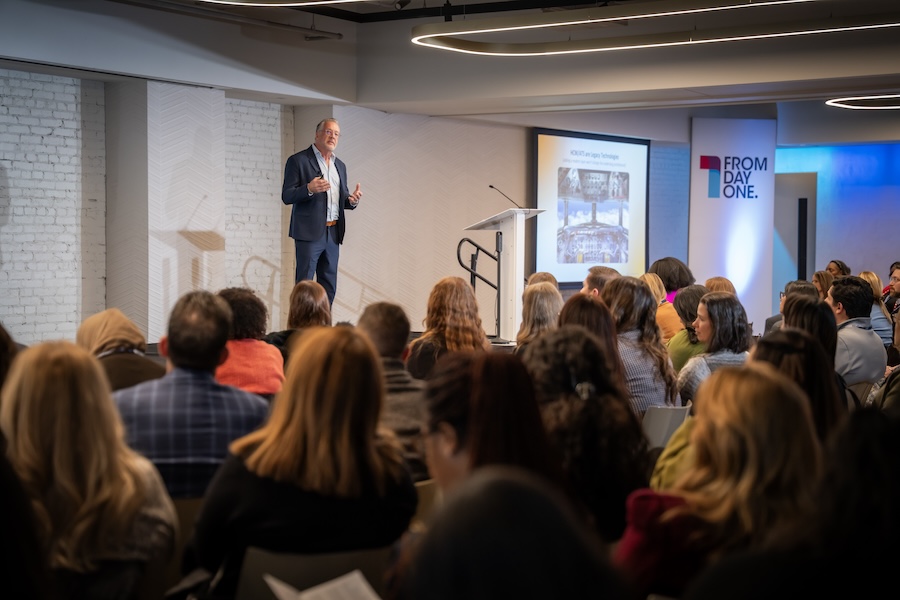
The problem, he says, is not that any individual tool is flawed. It’s that organizations are trying to modernize old infrastructures instead of redesigning them. “What we’re talking about now is really slapping iPads on old cockpits and calling it a modern infrastructure,” he said. “And it’s not.”
Amplifying the Human Value of Work
Despite the anxiety surrounding AI, Jurkiewicz emphasized that its role in HR is not about eliminating human work. Instead, AI should remove repetitive tasks so people can focus on more meaningful responsibilities.
“How do we amplify the human value of work?” he asked. “How do we get rid of the busy work, the things that we shouldn’t be doing?”
Tasks like interview scheduling, applicant ranking, and document processing can increasingly be handled by AI-driven systems. But removing administrative work does not eliminate the need for people. Instead, Jurkiewicz sees a shift in how HR functions are structured.
“What is happening is a realignment of work,” he said.
In that realignment, areas such as talent strategy, learning and development, and compensation planning will likely grow. These functions rely heavily on human judgment, insight, and relationship-building—areas where technology can assist but not replace people.
Technology alone will not determine whether AI adoption succeeds. According to Jurkiewicz, the most important factor is culture. “The first thing we start with is culture,” he said. “Culture is the one driver of AI fluency that guarantees its success.”
Organizations that successfully build AI capability typically start small, experimenting with tools across teams and measuring the outcomes. Often, high-performing teams are paired with struggling teams so both groups can test and learn from new workflows. These bottom-up experiments frequently reveal a surprising pattern.
“Leadership happens to be the biggest blocker to building AI fluency,” he said. Managers and individual contributors often adopt AI tools more quickly because they see immediate benefits in their daily work.
Another shift Jurkiewicz believes will accelerate is closer collaboration between HR and IT. As AI becomes embedded across enterprise workflows, workforce strategy and technology infrastructure can no longer operate independently. “People plus technology is going to be what drives outcomes in your organization,” he said.
Some companies have already begun restructuring around this idea. Moderna recently combined HR and IT under a single leadership role focused on productivity and transformation. Even when formal restructuring isn’t possible, Jurkiewicz encourages organizations to align the two departments around shared success metrics.
Looking Beyond Efficiency
When discussing AI adoption, many companies still frame the business case around efficiency. Automating administrative tasks can certainly reduce workload, but Jurkiewicz says that efficiency is only part of the story. “Efficiency is finite,” he said. “Revenue is infinite.”
When organizations free employees from routine work, new opportunities often emerge—new markets to explore, new products to develop, and new ways to deliver value. Those opportunities, he said, often represent the real return on investment.
Jurkiewicz closed his session by revisiting the language commonly used to describe human involvement in AI systems. Many technology leaders talk about keeping a “human in the loop,” meaning that people remain responsible for reviewing automated outputs. “You’re going to hear this term ‘human in the loop’ a lot,” he said. “It is wrong.”
Instead, he prefers a different phrase.“The term they should be using is human in the lead,” Jurkiewicz said. “When you say human in the lead, it means I’m putting you in charge of the outcomes.”
In aviation, pilots follow a simple rule: aviate, navigate, communicate—fly the plane first. For Jurkiewicz, the same principle applies to organizations navigating the AI era. Technology may provide powerful new instruments, but it is still people who determine where the journey goes.
Editor’s note: From Day One thanks our partner, Phenom, for sponsoring this thought leadership spotlight.
Chris O’Keeffe is a freelance writer with experience across industries. As the founder and creative director of OK Creative: The Language Agency, he has led strategy and storytelling for organizations like MIT, Amazon, and Cirque du Soleil, bringing their stories to life through established and emerging media.
(Photos by Josh Larson for From Day One)