Brand Worlds Are the Next Marketing Frontier
BY Grace Turney
|
April 29, 2026

Chad Reynolds spent 25 years traveling the world to understand consumers. He interviewed people in their homes, in markets, in unfamiliar cities, only to return and watch those hard-won insights get second-guessed in a conference room. The problem was never the ideas; it was the room itself.
“I always dreaded entering this room,” Reynolds recalled, describing the classic focus group setup. “It wasn’t the people, I love people. It was just, they had no real context for what we were trying to solve. It was luck of the draw.”
That frustration became the foundation for Vurvey Labs, the AI company Reynolds founded and now leads as CEO. During a thought leadership spotlight at From Day One’s Silicon Valley marketing conference, Reynolds laid out a sweeping vision for what he calls “people models,” or AI systems built not from scraped internet data, but from millions of real human voices, emotions, and behaviors. His argument: companies that keep treating AI as a productivity tool are missing the bigger opportunity entirely.
Real, Synthetic, and Surreal
Reynolds frames the current AI landscape as operating across two modes: the “real” world, where human beings live, feel, and act irrationally, and the “synthetic” world, where AI agents and simulated environments do what they’re programmed to do. Most companies, he says, are stuck at one pole or the other.
The more interesting territory, he says, lies between them—a space he calls “surreal.” Borrowing from the artistic movement that sought to surface unconscious, dreamlike states, Reynolds uses the term to describe a mode of thinking and building where human experience and artificial intelligence genuinely synthesize.
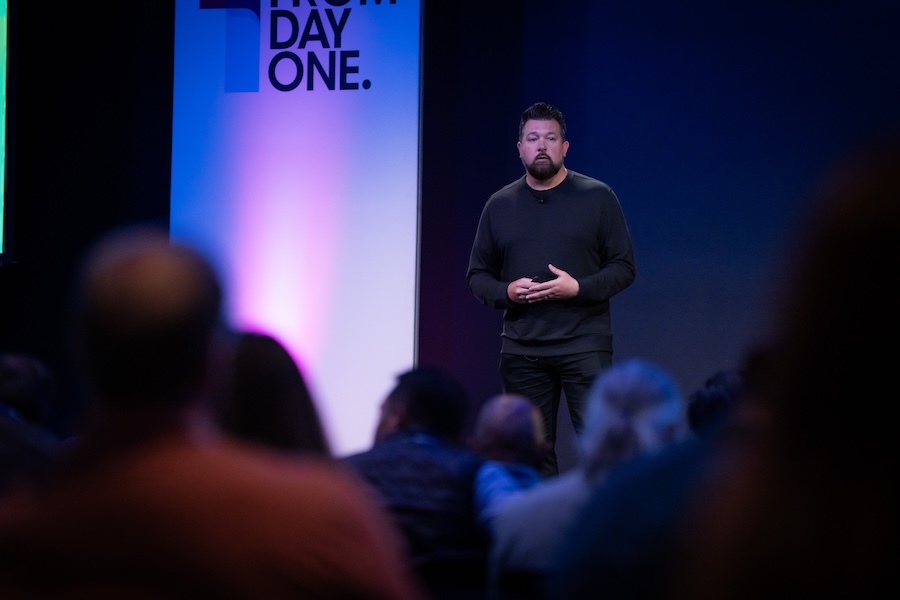
“Surrealism actually started as a writing movement, not painting,” he said. “When you think about how we experience the world in different ways, to truly take advantage of what AI can do, you have to live in that surreal space, because that’s where all the messy stuff happens. Where a consumer likes something one minute, and completely changes their mind the next.”
Most AI systems, Reynolds says, are optimized for language but not for people. Large language models are trained on internet data that skews toward the average, producing what he calls “the mean,” the top of the bell curve. “That’s great,” he said, “but I want the edges. I want the whole bell curve. That’s where the gold lives—in the people who see the world differently.”
Building a Haystack of Needles
Vurvey Labs takes a different architectural approach. The company, whose name is short for “video survey,” holds a patent on a video-based survey method that pushes questions to the phones and devices of more than 3 million people around the world. Their responses, including not just text but also video and emotional expression, feed into what Reynolds calls a “people model” rather than a conventional language model.
From that foundation, the platform generates synthetic consumer populations, not single AI personas, but thousands of distinct individuals drawn from real behavioral and contextual data. The goal is to move consumer insight beyond the familiar archetype of “Jane,” a persona trapped in a PowerPoint deck, and into something dynamic.
“What if Jane could talk back?” Reynolds said. “What if it wasn’t just Jane, but thousands of other Janes with all different types of lived experience, from all over the world, who could give you feedback?”
The platform is already in use at scale. Unilever, an early adopter, has rolled it out across more than 30 markets and all major categories—generating AI populations of consumers for brands like Dove and Hellmann’s, says Reynolds. Rather than restricting consumer insights to research teams, the approach lets product, marketing, and innovation staff across the company test and develop ideas directly with simulated consumer segments.
“We always talk about being consumer-centered or consumer-obsessed,” Reynolds said. “This has been an amazing way for companies to have their senior leaders say: here is the consumer. We’re distributing them to everybody in the company.”
Focusing on Audience Specificity and Preferences
One of the more striking applications Reynolds shared was what Vurvey Labs calls the “neuroverse,” a population of neurodivergent consumers built from recruited participants across the autism spectrum, with ADHD, dyslexia, and other conditions, including non-verbal individuals and those who contributed via sign language.
The motivation, Reynolds says, goes beyond inclusion as a value. More than 53% of Gen Z identify as neurodivergent, he noted. For any brand targeting that generation, ignoring the neurodivergent population means missing roughly half the audience, and potentially designing communications that simply don’t land.
During this past year’s Super Bowl, Vurvey Labs ran the entire ad lineup through the neuroverse population in parallel with the general public. The results diverged significantly. The Budweiser commercial ranked first in USA Today’s Ad Meter among the general audience. Among the neurodivergent population, it scored far lower. The gap, Reynolds says, is precisely the kind of signal that traditional focus groups and even most AI tools would never surface.
“It wasn’t to critique the ad,” he said. “It’s just to understand, as you’re trying to design stories, how do you actually engage the entire audience? You don’t need to be relevant for everyone, but you should understand how to be more accessible and how to deliver a message that lands.”
The same logic drives other niche populations the company has built, including a database of nearly 47,000 contractors for a major home improvement retailer, enabling that company to test concepts, loyalty programs, and product ideas with a hard-to-reach audience at scale and in real time.
Simulation as Standard Practice
Reynolds predicts that within three to six months, the word “simulation” will become ubiquitous in business conversations—a shift as significant as when “cloud” or “platform” entered the mainstream lexicon. The analogy he reaches for is Sim City: a world you build, control, and test inside before committing to it in the real one.
“Rather than the rest of the world having access to it, you and your team have access to it,” he said. “You can test ideas. You can build things. You can explore the future.”
He was careful to frame the technology not as a replacement for human research, but as a complement to it. Vurvey Labs runs ongoing validation studies, comparing what its populations surface against findings from interviews with actual humans. What has surprised even Reynolds’ team is that the AI populations sometimes raise themes that humans don’t explicitly name – but immediately confirm when those themes are reflected back to them.
“They just didn’t want to talk about them,” he said. “So what can we learn by understanding what’s in the subtext of what our consumers are saying? Can we actually increase what we’re discovering?”
The design school metaphor Reynolds keeps returning to captures the spirit of what he’s building: a system where you put your idea on the wall and let a diverse, critical audience tear it apart, not to discourage creation, but to sharpen it. The difference is that the audience now numbers in the thousands, spans the globe, and is available at any hour.
“For us to get somewhere new,” Reynolds said, “we need people models to exist. It’s less about a tool, and more like entire worlds we’re building.”
Editor’s note: From Day One thanks our partner, Vurvey Labs, for sponsoring this thought leadership spotlight.
Grace Turney is a St. Louis-based writer, artist, and former librarian. See more of her work at graceturney17.wixsite.com/mysite.
(Photos by Josh Larson for From Day One)