Marketing at the Speed of Light: How to Get the Pitch Across When the Product Is Changing Fast
BY Ade Akin
|
April 27, 2026

What does it take to market a company that may not be a household name, but powers the technology people rely on every day—from Face ID in your smartphone to the undersea fiber optic cables connecting continents?
Sanjai Parthasarathi expected a conversation about market segmentation with Coherent’s founder when he was appointed as the company’s first Chief Marketing Officer in 2019, but, instead, he received a piece of advice that has fundamentally reshaped how the photonics giant tells its story. “He says, ‘Hey, Sanjai, by the way, we have two types of customers, and I want you to market to both of them,’” Parthasarathi recalled. “Those who buy our products. And then he says, ‘I also want you to market to those who buy our stock.’”
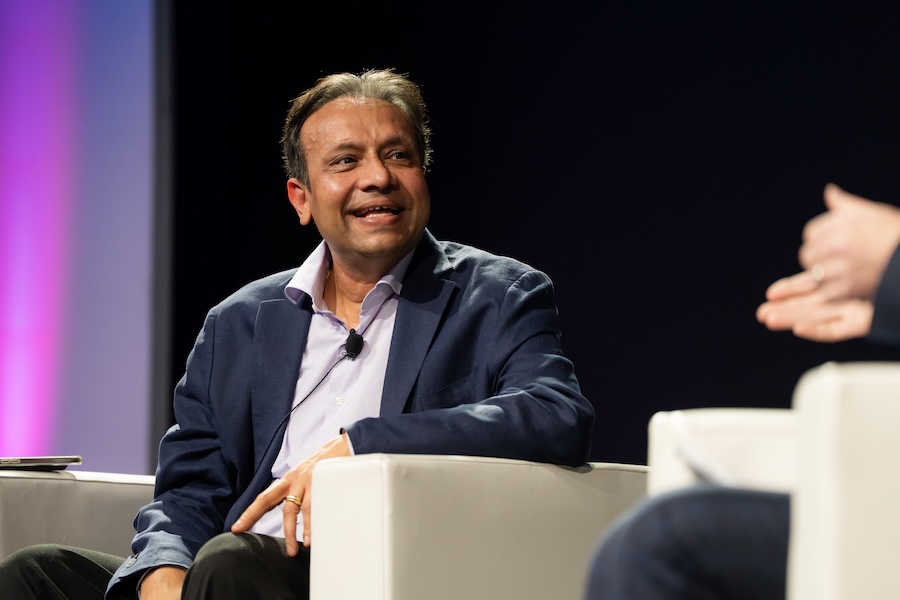
Parthasarathi shared this and other insights during a fireside chat about, “Marketing at the Speed of Light: How to Get the Pitch Across When the Product Is Changing Fast” at From Day One’s Silicon Valley marketing conference.
Parthasarathi offered a closer look at a company whose products are everywhere in a conversation with Steve Koepp, co-founder and editor in chief of From Day One. His mandate, he says, is to crystallize the story of technology quietly powering the AI revolution, data centers, and modern manufacturing, and tell it to two very different audiences.
From the Periodic Table to AI Data Centers
Parthasarathi started the conversation by demystifying “photonics,” which he describes as “the science of light, the technology that goes into creating light and manipulating light and sensing light.”
The examples were as tangible as they were ubiquitous. “When I wake up, the first thing I do is I look at my phone, and you know the magic of Face ID and the phone completely opening up by looking at your face,” he said. “That’s made possible in photonics.” Those signals don’t stop there. They travel from your phone to an RF tower, where an optical transceiver converts electrical signals into optical signals, sending them through fiber optic networks, including undersea cables, to reach a friend in Singapore.
Coherent’s story started in 1971, in Pittsburgh, with a name so esoteric it requires a chemistry lesson. Originally called “II-VI,” a reference to the group's two and six on the periodic table, the company was founded on materials like zinc selenide and cadmium telluride, designed to shape and direct beams for the then-new carbon dioxide laser.
Over the decades, the company evolved into a diversified photonics powerhouse, acquiring Bay Area-based Finisar in 2019 and later adopting the name of its 2022 acquisition, Coherent, a brand synonymous with laser excellence.
Today, Coherent’s technology is a cornerstone of the AI boom. “All the connectivity within the data center is all optical,” Parthasarathi said. “The connectivity from one end of the rack to another, I mean, these data centers are huge. And finally, all the connectivity, all the data that leaves the data center, it’s all optical.”
One Portfolio, Two Extremes
Marketing for such a diverse company presents unique challenges. Coherent serves both “hyper-scale” data center customers, each of which, Parthasarathi noted, is “a market by themselves,” and thousands of industrial and academic customers who buy standard products.
“For our hyper-scale customers, it’s all a very high-touch, technical marketing activity that goes on,” he said. “We’re talking about long design cycles. We’re talking about partnerships and developing new platforms and technology.” On the other end of the spectrum, the team relies on more traditional demand generation and content campaigns.
Dealing with this technical complexity requires a marketing team that can speak the language of engineers and scientists. While Parthasarathi jokes about his doctorate, he emphasizes that technical competence is non-negotiable. “You don’t need to be an expert in the technology, but you need to understand it deep enough that you can have a productive dialog with your customer,” he said.
Coherent has centralized its marketing “brains” in a small Bay Area team to streamline its global operations, while a larger group in Malaysia handles content execution, a model that has proven efficient since its launch less than a year ago.
The Next Optical Frontier
One of the most significant shifts underway in the tech industry is the migration from electrical to optical signals, even within the tight confines of a server rack. “When you need to go fast, and we need to go long distances, you have to go optical.”
He paints a picture of future circuit boards with fiber traces instead of wires, a transformation that pundits estimate could multiply the market opportunity tenfold. This future is already being underwritten. In March 2026, Nvidia announced a $2 billion investment in Coherent as part of a multi-year partnership to advance optical technologies used for AI data center infrastructure.
Perhaps the most surprising insight of the chat came when Parthasarathi recalled his appointment as Coherent’s first Chief Marketing Officer in 2019. The company’s founder pulled him aside after the formal offer meeting and shared some advice that would redefine his role, asking him to market the company to consumers and stock buyers.
This directive has made investor communication a core part of Parthasarathi’s marketing strategy. “Ours is a complex story, and trying to simplify it for the investor audience is something that I spend a lot of time on,” he said.
While the messages differ, the fundamental task remains the same: crystallizing the company’s technological story for a specific audience. “It’s ultimately about taking the technology and taking the story and crystallizing it for the audience. That’s marketing, right, whether it’s an investor audience or customer audience or a supplier.”
Strategy, Storytelling, and the Limits of AI
Parthasarathi offered a grounded perspective as the conversation turned to artificial intelligence’s role in marketing. Coherent uses AI extensively for content generation and demand creation, but it’s clear about its limits. “AI is not going to tell me a story that has not been written yet,” he said. “Us as marketing folks, we’re writing the story. AI helps us refine the story.”
For Coherent, AI remains a powerful tool in a highly technical B2B industry, where understanding customer pain points and translating complex technology into value is paramount, but it’s not a replacement for deep market knowledge.
He emphasizes that successful marketing at Coherent is fundamentally a strategic function, sitting at “the intersection of markets, technology, and strategy.” This approach has underpinned the company’s ambitious growth, from a sub-billion-dollar revenue base a decade ago to a consensus estimate of around $7 billion for the current fiscal year.
“Strategy is not done in a vacuum by two people from the executive team,” Parthasarathi said. “It’s done with multiple functions, and it’s a long-term plan.”
Parthasarathi left the audience with a simple but powerful reminder as the session concluded. “Ultimately, it’s about the customers—what are the pain points that they’re having, what are the challenges that they’re trying to solve. And the realization of that is perhaps the most important thing that you can do as a marketing professional.”
Ade Akin covers artificial intelligence, workplace wellness, HR trends, and digital health solutions.
(Photos by Josh Larson for From Day One)