Smart Tools, Smarter Hiring: Using AI to Elevate Hiring Decisions
BY Ade Akin
|
March 19, 2026

Employees at BNY are not just learning to work with AI, they’re building with it. Johanna Bazos, the company’s head of executive recruitment, corporate and talent research engine, recently became “Eliza certified,” meaning she can now create autonomous agents on the firm’s proprietary AI platform.
Since then, Bazos has built agents that assist with interview briefings, competency development, and feedback collection, all without writing a single line of code. “I am not, by any extent of the imagination, a techie or a coder at all,” Bazos said during an executive panel discussion at From Day One's NYC half-day talent acquisition conference. “But the tools that the company has provided all employees—and 98% of all employees have taken advantage of this—are really showing how leadership has democratized AI.”
This grassroots adoption of generative AI was a recurring theme among the talent acquisition leaders gathered for the panel discussion titled “Smart Tools, Smarter Hiring: Using AI to Elevate Hiring Decisions,” moderated by Corinne Lestch, journalist and founder of the Off-Site Writing Workshop.
Redefining the Recruitment Process as a Human-Centric Journey
For many organizations, the shift to AI-powered recruiting has prompted a fundamental rethinking of how talent acquisition teams operate. At BNY, this has meant moving away from viewing recruiting as a series of transactional steps and toward seeing it as a continuous candidate journey that prioritizes human connection.
“The most important transformation at BNY has been around mindset,” Bazos said. “It’s thinking about talent acquisition as a journey, rather than specifically as a process where you’re filling roles.”
Using a journey-based approach allows recruiters at BNY to identify the “moments that matter” in the candidate experience, such as the first conversation, the offer presentation, and the onboarding process, and deliberately inject human emotion into these touchpoints.
“Many of us have the same available tools through AI like Copilot, ChatGPT,” Bazos added. “It’s going to be about that differentiating factor of how human-centric you can be.”
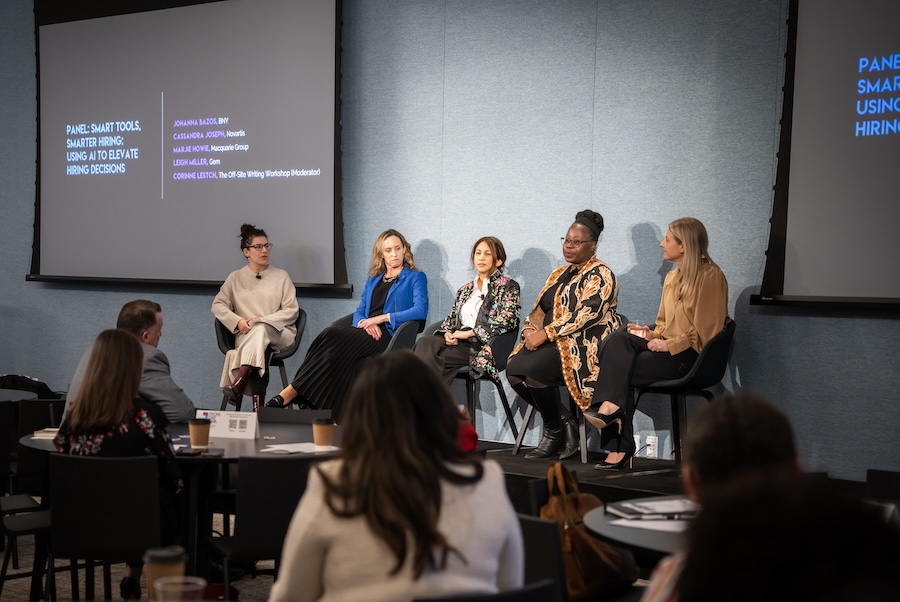
At Macquarie Group, that human-centric focus means using technology to free recruiters to focus on what matters most: conversations with potential candidates. “The most important thing that they can be doing is talking to candidates and having an advisory conversation with hiring managers,” Marjie Howie, the head of talent acquisition for the Americas at the financial services firm, elaborated. “The more time that they can spend on the phones with candidates, the better.”
To help achieve that goal, Macquarie has developed internal chatbots that answer basic recruiting questions for hiring managers, such as how to open a job or obtain headcount approval, so recruiters don’t have to. The company also created a prompt library with dozens of detailed prompts that help to reduce the administrative load on recruiters, such as drafting call notes or synthesizing market intelligence.
AI Adoption Starts With Leadership Alignment
Leigh Miller, senior customer talent advisor at Gem, says a sense of ownership is vital for the successful adoption of AI. She has seen what happens when such ownership is missing in her work as she helps companies implement new technology. It turns change management into an uphill battle.
“When implementing Gem with customers, we’ve actually slowed down the implementation because recruiters weren’t bought in,” Miller said. “If they’re not excited, they don’t know why they’re getting it, they don’t see a problem in the first place; they are absolutely not going to adopt it.”
At Macquarie, Howie’s team has avoided pitfalls by creating working groups that give recruiters a stake in the hiring process, ensuring leadership alignment extends beyond members of senior management to the people doing the work required daily. “The team feels like they own the process. It’s not happening to them. They’re part of it,” she said. “And I feel like that’s exciting for them. It’s not scary.”
Navigating Compliance and Regulatory Risks in a Global TA Function
Organizations in heavily regulated industries require a more measured approach for AI adoption. Cassandre Joseph, the global head of TA and R&D at Novartis, oversees a team of over 200 people across multiple countries, each with its own compliance requirements. “There are just so many different regulatory risks in every one of the countries,” Joseph said. “Data privacy, particularly in Europe, is huge.”
This reality has forced Novartis to take what Joseph calls a more thoughtful approach to AI adoption, slowing things down as others speed up, asking thorough questions about what each tool achieves, and bringing leaders from legal, compliance, and global data privacy into every decision.
"We want to understand: What are the algorithms that went into it? How were the algorithms built?" Joseph added. "We're really [focused] on layering and ensuring that we can peel back the layers to truly understand: Will this tool, yes, it might make us move a little bit faster, but will it create further regulatory risks for the organization from a legal standpoint?"
The cautious approach to AI integration at Novartis hasn't prevented innovation. The company has deployed an AI coach that is available to the entire HR team, helping members to become better advisors by practicing different scenarios and asking better questions. The AI coach allows recruiters to work through challenging situations, without inputting identifying candidate information, to refine their approach.
Bridging the Candidate Experience Gap Through Technology Integration
One of the most pressing challenges facing talent acquisition teams today is the perception gap between what employees think they’re providing and what candidates actually experience. Social media is filled with candidate complaints about being “ghosted” by employers or sending applications into what feels like a black hole. These are clear indicators of poor candidate engagement.
Contrary to popular belief, AI isn’t automatically screening out most candidates. “We screen every application,” Joseph said. “There are a lot of legal reasons why we don’t adopt that technology just yet.” For now, every resume is reviewed by a human at Novartis.
The real challenge is the volume of applications coming in. “Last year, we saw a 20% increase in applications, and I know it’s probably going to continue to rise,” Joseph said. “So what do you actually do?” She says her team is now exploring how AI tools can help create more human-centric messages and deploy them at the right time in hopes of avoiding situations where candidates receive rejection letters a few hours after applying.
At Macquarie, the applicant tracking system (ATS) doesn’t auto-disqualify any candidates. “There is a human in the loop for the entire process,” Howie said. The organization works closely with its employer brand team to craft thoughtful rejection messages and invites candidates to join its customer relationship management (CRM) system, where they receive content about upcoming events and other company news. “We’re hoping that we’re using AI to bridge this communication gap, not strengthen it,” she added, demonstrating intentional technology integration that's aimed at enhancing the candidate experience.
Workflow Optimization Through a Human-Centric Lens
All four panelists agreed that the fundamentals of talent acquisition remain intact despite the rapid technological changes unfolding. Joseph warns against simply layering tech stacks upon each other without closely examining whether the underlying processes are sound.
“We really need to get back to the basics,” she said. “At the end of the day, as folks within talent acquisition, it is: How do we help leaders make the right decisions to bring the right people into the organization? How do we help candidates find the right opportunities that work for them?”
Miller framed it as the interplay of people, processes, and technology. “AI in recruiting is having a moment, rightly so,” she said. Miller says effective workflow optimization requires balancing all three elements.
For Bazos, it comes down to remembering that behind every application is a person. “These are individuals with careers, families, trying to pay for mortgages and schools,” she said. “Carry that [idea] through the entire talent acquisition journey, keeping it human-centric at every step.”
Ade Akin covers artificial intelligence, workplace wellness, HR trends, and digital health solutions.