Learning and Development, Powered by AI: How Innovations Are Bringing the Next Wave
BY Emily McCrary-Ruiz-Esparza
|
March 06, 2026

“Already, I can’t go back to not having AI,” said Stephanie Smith-Ejnes, the VP of people and organization at Sony Pictures. “It is so ingrained in my day-to-day work and how efficient I am and how efficient my team is. The path forward is seeing AI as a force-multiplier and not a replacement for learning professionals.”
Given the number of creatives employed by Sony, the will-it-or-won’t-it replace-me conversation is one Smith-Ejnes has been having a lot lately. And while she can’t imagine her working life without it, she’s sympathetic to those who still see it as a threat to their livelihood. It’s up to leaders like her, she explained, to lead the way with AI adoption, making the case for it as an enabler, and not a threat.
During a panel discussion on how L&D teams are innovating with artificial intelligence at From Day One’s February virtual, Smith-Ejnes and her fellow panelists outlined how they’re pioneering AI in their organizations, setting the standard for adoption and responsible use.
Building an AI-Native Organization
Despite its widespread adoption, many companies and teams are far from proficient in AI. Talent development platform Infopro Learning uses a three-stage maturity model when helping clients advance. The first—and necessary—step is the “bolt-on” stage in which teams are curious and exploring with tools by adding them to existing processes, said CEO Sriraj Malick.
The second is when teams are learning how to use AI to save time and money, creating new work capacity. Companies enter the third stage—that is, the AI-native stage—when teams can work within an AI infrastructure.
“The infrastructure is learning as your team members are doing, so the knowledge and the intelligence compounds for the organization, for the team, and for every team member,” Mallick said.
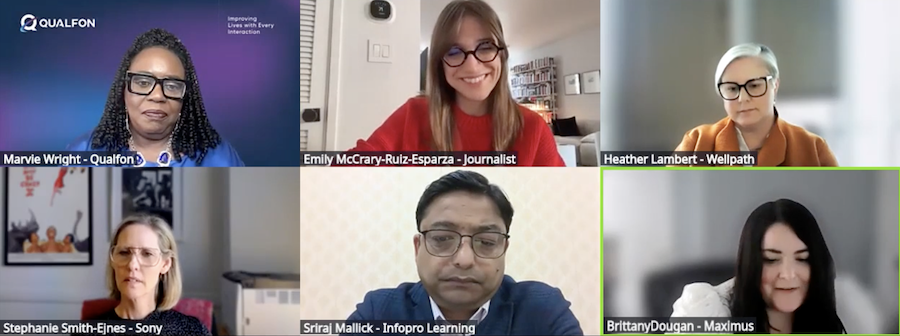
Companies advance at different speeds, of course, and even the most innovative are still experimenting.
For instance, customer-service platform Qualfon has developed its own AI-powered roleplay simulator to help employees master customer conversations. Learners have always asked for more practice, said the company’s VP of learning and development Marvie Wright, and now they can get it. Not only are these sessions measurable (tracking how quickly someone speaks or whether they over-use vocalized pauses like ums and ahs), “it also allows us to individualize and personalize the learning, and it gives immediate feedback,” she said. Personalization is something L&D teams have long talked about, “but finally, it’s a reality.”
As AI promises to automate rote tasks that have previously occupied inordinate amounts of time, human skills are becoming the most necessary and coveted, says Brittany Dougan, senior director of L&D at government services contractor Maximus. The good news is, “we’re really good at them, and we know how to develop them in the organization, so it puts [L&D teams] in a position to be true business partners.”
The Problem of Compliance
Some leaders in tightly regulated industries, like defense and healthcare, are finding AI adoption a challenge. “Compliance cultures are built on control and documentation, but really meaningful AI adoption requires iteration and failure and learning—it’s structured freedom,” said Heather Lambert, the VP of learning and development at healthcare provider Wellpath.
To afford workers with as much freedom as possible, Wellpath uses sandbox environments in which users are given access to tiered permission zones based on clearance and need, with guardrails to prevent users from mishandling data. “When people understand that there is a boundary and why it exists—whether it’s HIPAA or data privacy—they’re more likely to respect it,” said Lambert. “If they know why, they won’t try to work around it.”
“L&D teams will be the ones to set the standard for AI use within an organization,” said Smith-Ejnes. “If I sit back and I say, ‘let’s just wait and see what this is going to be,’ then the decisions are going to be made for me. But if we jump in as a strategic partner, then we become decision-makers with the business.”
Emily McCrary-Ruiz-Esparza is an independent journalist and From Day One contributing editor who writes about business and the world of work. Her work has appeared in the Economist, the BBC, The Washington Post, Inc., and Business Insider, among others. She is the recipient of a Virginia Press Association award for business and financial journalism. She is the host of How to Be Anything, the podcast about people with unusual jobs.
(Photo by Kosamtu/iStock)